This text forms part of a chapter in my forthcoming book for postgraduate students across international universities, titled Uncertain Futures: Sustainability and Global Risk. It is a chapter shaped…
This text forms part of a chapter in my forthcoming book for postgraduate students across international universities, titled Uncertain Futures: Sustainability and Global Risk. It is a chapter shaped by years of academic engagement—whether through teaching sustainability and development at the American University of Sharjah, lecturing as a visiting professor at other institutions, or speaking at global conferences as a public speaker. With every lecture delivered, every discussion held with graduate students, and every international forum I participate in, one truth becomes clearer: uncertainty is not a regional condition—it is a global reality.
For centuries, humanity believed the future could be read through steady patterns and predictable trajectories. Today, those assumptions no longer hold. We live in a time when the world can change in months, sometimes in weeks. Certainty has become a luxury, forecasting a challenge, and strategic planning a daily struggle. The world no longer moves according to fixed rules, but through shifting dynamics where environment, economy, technology, and geopolitics intersect in ways that defy traditional understanding.
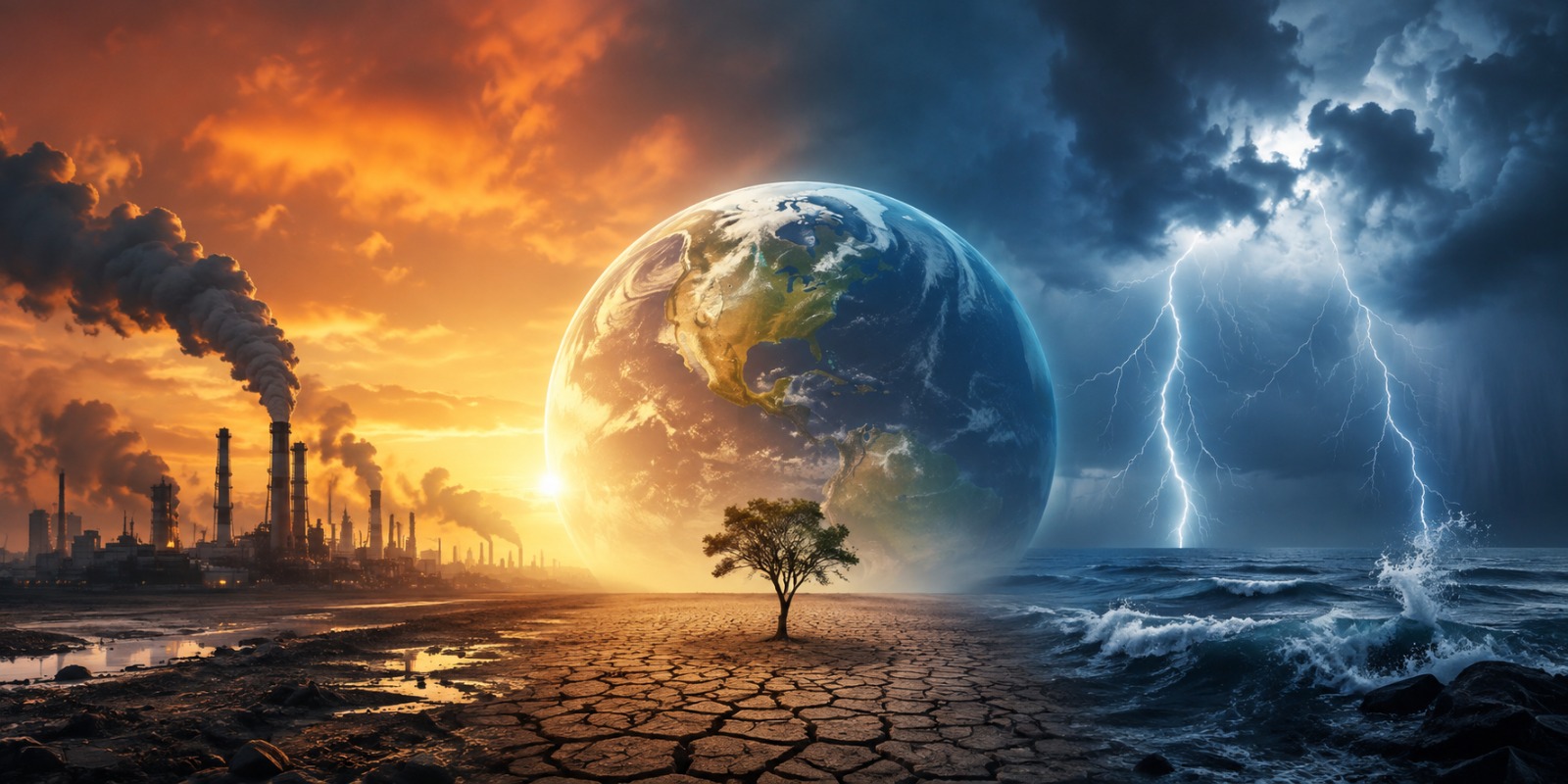
Environmental instability is perhaps the most visible sign of this new era. Canada has witnessed the largest wildfire season in its history, burning millions of hectares and sending smoke across the United States and even parts of Europe. India has endured heatwaves surpassing 50°C, turning daily life into a test of endurance. Europe has faced unprecedented floods that destroyed infrastructure once considered among the most resilient in the world. Across Africa, drought continues to threaten food security for millions. Australia’s bushfires have become an annual phenomenon, and the United States faces increasingly powerful hurricanes that expose the fragility of coastal systems.
One scientific example I highlighted in a previous article illustrates the scale of this transformation. A study by the University of Leicester revealed that some forests—long regarded as the planet’s lungs—are shifting from absorbing carbon dioxide to emitting it. This reversal was not anticipated in traditional climate models. It signals a deeper truth: ecosystems themselves are becoming unstable, and what we once assumed to be constant is no longer guaranteed. This finding stands as one of the clearest indicators that environmental uncertainty is not a temporary disruption but a structural shift in the planet’s ability to regulate itself.
Economic uncertainty mirrors this environmental turbulence. China’s economic slowdown—its first in four decades—has disrupted global supply chains. The United States faces market volatility driven by rapid advances in artificial intelligence. Europe grapples with energy insecurity following the war in Ukraine. Latin America continues to experience recurring financial crises, with countries like Argentina and Brazil struggling to maintain long-term economic stability. In Africa, emerging economies remain vulnerable to fluctuations in food and energy prices, often dictated by external forces beyond their control.
Technology adds another layer of complexity. In the United States, major tech companies have introduced AI systems capable of making complex decisions, raising questions about the future of work. Japan is integrating robots into healthcare. Europe is drafting new regulations to govern AI amid concerns over privacy and employment. South Korea’s smart cities rely on advanced data systems, while Singapore uses AI to manage traffic, air quality, and urban planning. China leads the global race in industrial robotics, reshaping the nature of labor worldwide. Technology promises progress, but it also brings ethical and social dilemmas humanity has never faced at this scale.
Migration is yet another expression of global uncertainty. The recent movement of thousands from Morocco into Ceuta is not an isolated incident—it is part of a broader pattern. People are crossing borders in search of safety, stability, or opportunity, driven by economic pressures, climate change, or political instability. Similar scenes unfold at the US–Mexico border, across the Mediterranean, and throughout Southeast Asia. Migration today is not merely a human movement; it is a symptom of deeper global imbalances and widening gaps between those equipped for the future and those left behind.
Geopolitics, too, is marked by hesitation and ambiguity. The world’s cautious stance toward a potential conflict involving Iran reflects this complexity. It is not a matter of military capability; rather, it is the recognition that global alliances are shifting, interests are evolving, and decisions of war and peace are now made under layers of political, economic, and security uncertainty. This hesitation is not weakness—it is a reflection of a world where the consequences of any major geopolitical decision ripple across continents.
Amid all these transformations, the human being remains at the center. Lifestyles are changing, values are evolving, and psychological pressures are rising. Anxiety about the future has become a global phenomenon. Yet, within this uncertainty lies opportunity. Human adaptability, creativity, and resilience offer pathways to rebuild systems with greater flexibility and sustainability.
Understanding this century is the first step toward navigating it. Sustainability is no longer an academic concept—it is a framework for interpreting the world as it is, not as we wish it to be. Despite its turbulence, this century holds immense potential for those who possess the tools to understand it and the courage to engage with its challenges.
It is a turbulent century… an uncertain future… but also a future open to those who approach it with knowledge, vision, and determination.
Back to news