Green hydrogen catalyst research at United Arab Emirates University (UAEU) has produced a new material made from desert sand, date-pit biochar and nickel. The approach turns locally available…
Green hydrogen catalyst research at United Arab Emirates University (UAEU) has produced a new material made from desert sand, date-pit biochar and nickel. The approach turns locally available resources and agricultural waste into a functional catalyst with potential for hydrogen production and other clean-energy applications. The work also reflects a broader effort to combine sustainable materials, circular-economy principles and energy research.
The research team included specialists from UAEU’s Chemical and Petroleum Engineering and Chemistry departments. Researchers also collaborated with Abu Dhabi Polytechnic. UAEU’s research grants program supported the project. The team reported its findings in the Journal of Alloys and Compounds. Elsevier publishes the international scientific journal.
Turning Desert Sand and Date Waste into a Clean-Energy Material
The study began with a simple question: can abundant desert sand become part of a useful catalytic material? Sand offers availability and low cost, but it has limited catalytic activity on its own. The researchers therefore used it as a supporting base rather than the active component.
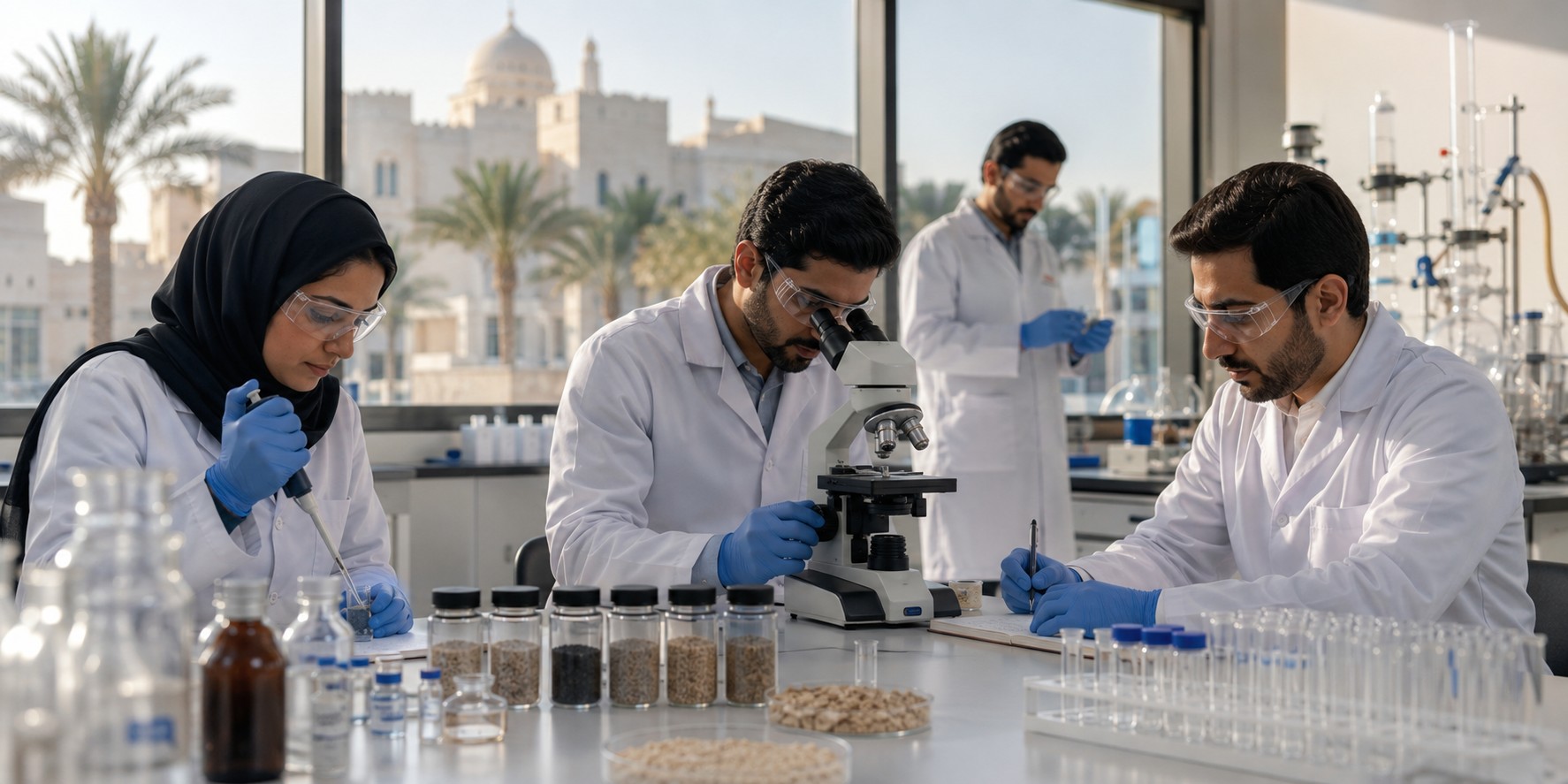
To create the green hydrogen catalyst, the team combined desert sand with biochar produced from date pits and added nickel as the active metal. This design gave each material a clear role. The sand provided structural support. The biochar improved the physical properties of the catalyst, while nickel drove the chemical reaction.
Using date-pit waste also added an important sustainability element. Date production generates agricultural residues across the region. Converting some of that waste into biochar creates a higher-value use for a material that might otherwise remain underused.
Optimizing a Sustainable Nickel-Based Catalyst
The researchers tested 30 different formulations to identify the most effective balance among the three ingredients. They compared how changes in composition affected nickel distribution, porosity and surface area.
The strongest formulation contained 15% nickel, 42.5% desert sand and 42.5% biochar. This mixture delivered the most promising combination of structural and catalytic characteristics.
Why Biochar Improved Catalyst Performance
The biochar helped spread nickel more evenly across the surface of the sand. It also reduced nickel agglomeration, which can limit the number of active sites available for reactions. At the same time, the biochar increased the material’s porosity and surface area.
These changes gave reacting molecules more space to interact with active nickel sites. The optimized material also showed a high hydrogen-adsorption capacity. Compared with a catalyst made only from sand and nickel, it achieved a much larger surface area.
The results show why material design matters in catalyst development. Performance depends not only on the active metal. It also depends on how effectively the supporting material holds and distributes that metal.
Methane Cracking Shows Early Hydrogen Potential
The team then tested the material in methane cracking. This process can produce hydrogen by breaking methane into hydrogen and solid carbon. Initial experiments showed that the green hydrogen catalyst converted about 38% of the methane at temperatures between 500°C and 600°C.
That result does not yet establish commercial readiness. However, it provides an early practical demonstration that the material can support hydrogen-producing reactions. The researchers still need to examine long-term stability, durability and efficiency under extended operating conditions.
Dr. Mohammad Noor Al-Tarawneh, from UAEU’s Department of Chemical and Petroleum Engineering and a co-author of the study, said the project demonstrates how locally available resources can support advanced clean-energy materials. He also highlighted the value of combining desert sand with date-pit waste in a material that remains relatively simple to prepare.
A Platform for Future Clean-Energy Materials
The study’s importance extends beyond one final formulation. The team used a systematic screening method to select the best composition from dozens of alternatives. Researchers could apply the same method to other metals, natural materials and waste-derived carbon sources.
That approach may help scientists design more sustainable catalysts while reducing dependence on expensive materials. It could also support research that connects local resource use with cleaner industrial processes.
The next phase will focus on performance over longer operating periods. The researchers plan to test whether the catalyst can retain its activity and whether they can reuse it effectively. They will also examine its behaviour under different operating conditions. Those results will help determine its practical potential.
If further testing confirms its durability, the green hydrogen catalyst could offer a useful model for combining clean-energy research with circular-economy thinking. More broadly, the study shows how universities can transform common local materials and agricultural waste into higher-value technologies with scientific and environmental relevance.
Back to news